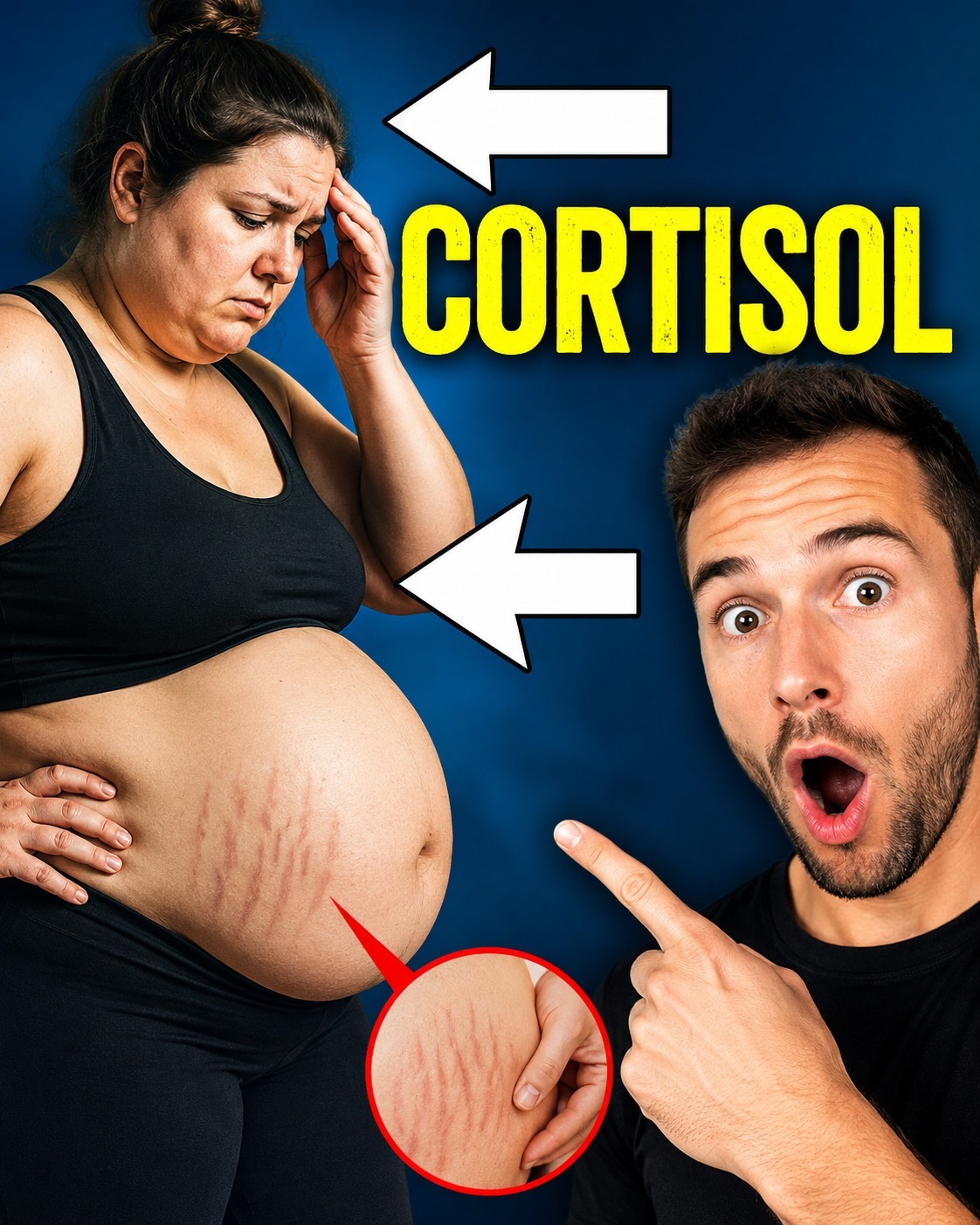
Cortisol is often called the “stress hormone,” but it is not a bad hormone by itself.
Your body needs cortisol.
It helps with energy, blood pressure, blood sugar, inflammation control, and stress response.
The problem starts when cortisol stays too high for too long.
That can happen because of long-term steroid medication use, certain hormone disorders, adrenal or pituitary problems, or a condition called Cushing syndrome. Mayo Clinic explains that too much cortisol can cause signs such as a rounded face, fatty hump between the shoulders, pink or purple stretch marks, high blood pressure, bone loss, and sometimes type 2 diabetes. (Mayo Clinic)
Now, let’s be honest.
Not every belly, stretch mark, or tired face means high cortisol.
Bodies change for many normal reasons.
But if several signs appear together and keep getting worse, it may be time to speak with a healthcare professional.
1. Weight Gain Around the Belly
One of the most talked-about signs of high cortisol is weight gain around the middle of the body.
This can show up as more fat around the belly, chest, upper back, or face.
People sometimes call this “stress belly,” but that phrase can be misleading.
Stress alone is not always the reason.
Chronic high cortisol from Cushing syndrome can cause body fat to collect more in the trunk area while arms and legs may look thinner. Cleveland Clinic describes Cushing syndrome as too much cortisol in the body, with symptoms including round face, fatigue, and weight changes. (Cleveland Clinic)
So yes, belly weight can be one clue.
But it is not proof by itself.
The body is complicated, unfortunately.
Very dramatic too.
2. Rounder Face
A noticeably rounder or fuller face can happen when cortisol stays high.
This is sometimes called “moon face.”
The face may look puffier, softer, or more swollen than before.
This change can happen slowly, so many people do not notice it right away.
They may only realize it when comparing old photos.
Again, a round face does not automatically mean high cortisol.
Weight gain, hormones, medications, salt intake, sleep changes, and many other things can affect facial shape.
But when a rounder face appears with belly weight gain, purple stretch marks, easy bruising, and muscle weakness, it deserves attention.
3. Fatty Hump Between the Shoulders
Another visible sign is a fatty pad around the upper back or between the shoulders.
People sometimes call this a “buffalo hump.”
It can make the neck and upper back look thicker.
Mayo Clinic lists a fatty hump between the shoulders as one of the main symptoms linked with too much cortisol in Cushing syndrome. (Mayo Clinic)
This sign can feel frustrating because it changes posture and appearance.
But it should not be judged or mocked.
It can be a real medical clue.
And medical clues deserve care, not shame.
4. Purple or Pink Stretch Marks
Stretch marks can happen for many normal reasons, including pregnancy, growth, weight changes, bodybuilding, and genetics.
But high cortisol can cause a different kind of stretch mark.
They may look wider, darker, purple, red, or pink.
They often appear on the belly, thighs, breasts, arms, or hips.
Mayo Clinic includes pink or purple stretch marks among the classic signs of Cushing syndrome. (Mayo Clinic)
If stretch marks suddenly appear and look darker or wider than usual, especially with other symptoms, it may be worth checking.
Not panicking.
Just checking.
5. Thin Skin and Easy Bruising
High cortisol can affect the skin.
The skin may become thinner and more fragile.
Small bumps may leave bruises more easily.
Cuts may take longer to heal.
Some people notice their skin looks more delicate or damaged than before.
This can be especially visible on the arms, hands, legs, or belly.
Easy bruising can happen from many causes, including aging, medication, vitamin deficiency, blood disorders, or skin changes.
But when it appears with other cortisol-related signs, it becomes more important.
Your skin may be trying to send a little message.
A slightly dramatic one, but still.
6. Acne or Oily Skin
Some people with high cortisol may develop acne or oily skin.
This can appear on the face, chest, or back.
For adults who suddenly develop acne after years of clear skin, it can feel confusing.
High cortisol can disturb hormone balance, and that may affect the skin.
Cushing syndrome can also cause skin changes such as acne, excessive hair growth, and easy bruising, according to OHSU’s clinical overview. (ohsu.edu)
Of course, acne has many causes.
Food, hormones, skincare products, stress, medications, and genetics can all play a role.
But sudden acne plus other body changes should not be ignored.
7. Thinner Arms and Legs
This one surprises many people.
High cortisol can cause weight gain around the belly and face, but at the same time, arms and legs may become thinner or weaker.
This happens because high cortisol can affect muscle tissue.
People may notice they lose strength.
Climbing stairs becomes harder.
Standing from a chair feels more difficult.
Carrying groceries feels weirdly exhausting.
Not exactly glamorous.
Muscle weakness and fatigue are commonly listed among high cortisol or Cushing syndrome symptoms. Cleveland Clinic notes high cortisol symptoms can include weight gain and other Cushing syndrome features. (Cleveland Clinic)
If your body shape is changing while your strength is dropping, that is worth discussing with a doctor.
8. Excess Facial or Body Hair in Women
Women with high cortisol may notice more facial or body hair.
This can appear on the face, neck, chest, abdomen, or thighs.
The NIDDK notes that women with Cushing syndrome may develop excess hair on the face, neck, chest, abdomen, and thighs, and menstrual periods may become irregular or stop. (Institut national du diabète et des maladies digestives et rénales)
This symptom can feel embarrassing, but it is not something to be ashamed of.
It is a hormonal sign.
And hormones are basically tiny managers in the body who sometimes make very questionable decisions.
9. Swollen-Looking Face or Body
High cortisol can sometimes make the body look puffy.
The face may seem swollen.
The belly may feel larger.
The body may hold onto more fluid.
This is not always obvious at first.
People may think they are just tired, eating too much salt, or not sleeping well.
And sometimes that is true.
But if the swelling or puffiness comes with high blood pressure, high blood sugar, purple stretch marks, and muscle weakness, it becomes more concerning.
Cushing syndrome can also lead to complications such as high blood pressure and high blood sugar, according to Mayo Clinic and Healthdirect. (Mayo Clinic)
10. Mood, Sleep, and Energy Changes
This sign is not always visible from the outside, but people around you may notice it.
High cortisol can affect mood, sleep, and energy.
Some people feel anxious, irritable, depressed, wired at night, or exhausted during the day.
They may also struggle with memory or concentration.
This can be confusing because stress itself can cause similar symptoms.
That is why symptoms alone cannot diagnose high cortisol.
Testing matters.
The Endocrine Society explains that doctors may measure cortisol and ACTH levels and use additional testing to understand whether cortisol is truly high and why. (endocrine.org)
So if you feel “not like yourself” along with visible body changes, it is worth taking seriously.
When Should You See a Doctor?
You should consider medical advice if you notice several of these signs together:
Belly weight gain with thinner arms and legs.
A rounder face.
Purple stretch marks.
Easy bruising.
Muscle weakness.
High blood pressure.
High blood sugar.
Irregular periods.
Sudden acne.
Unusual hair growth.
These symptoms do not always mean high cortisol.
But they are enough to ask for proper evaluation.
A healthcare professional may suggest blood, urine, or saliva tests, and sometimes imaging, depending on the results. Diagnosis can be challenging in mild cases, and the Endocrine Society notes that the most common cause of Cushing syndrome is prescribed corticosteroid use. (endocrine.org)
What You Should Not Do
Do not self-diagnose from an image online.
Do not stop steroid medication suddenly.
Stopping corticosteroids without medical supervision can be dangerous.
Do not buy random “cortisol detox” pills.
Do not blame every body change on cortisol.
And please do not shame yourself.
Your body is not failing.
It may simply be asking for attention.
Final Thoughts
High cortisol can show visible signs such as belly weight gain, round face, upper-back fat pad, purple stretch marks, acne, easy bruising, thin skin, thinner arms and legs, swelling, and excess hair growth in women.
But these signs are not proof on their own.
They are clues.
The smart step is to notice patterns, check symptoms, and speak with a healthcare professional if several changes appear together.
Stress management, sleep, movement, balanced meals, and medical care when needed all matter.
Because real health is not about fear.
It is about listening early, acting wisely, and giving your body the attention it deserves.